
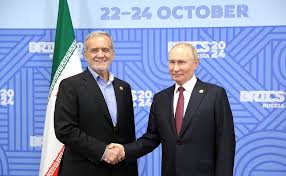
The Iran war exposes the limits of Russia’s leverage in a fragmenting regional order
The war will not affect Russian plans in Ukraine – but it will likely force a rethink of long-held Russian strategic concepts.
By Grégoire Roos, Director, Europe and Russia and Eurasia Programmes
Director, Europe and Russia and Eurasia Programmes
In a diplomatic note to the Iranian government dated 29 March 1944, Vyacheslav Molotov, then foreign minister of the Soviet Union, noted that ‘the Soviet Union [couldn’t] remain indifferent to the fate of Iran’. That statement crystallized a perennial tenet of Soviet foreign policy – one that still synthesizes much of Moscow’s approach to the Middle East today: Iran is not a dispensable peripheral actor. It is a structural node on the southern flank of the Russian Central Asian zone of influence.
The current military confrontation between Iran on the one side, and the United States (US) and Israel on the other, might well push this logic to its limits. Moscow may be forced to navigate a new and possibly perilous geometry of utility, ideology, and strategic restraint.
Depending on the war’s outcome, the Kremlin might see its already wobbly strategic architecture in the Middle East so badly undermined that it is compelled to reassess its regional calculus.
Russia’s reckoning
Russia’s public posture in response to the military action against Iran has been one of sharp rhetorical condemnation. Moscow has labelled the strikes ‘unprovoked acts of armed aggression’ and warned of regional and global instability unless diplomacy is restored.
But Russia will obviously not enter into any kind of military confrontation with the US and Israel. Nor has it sent Tehran the least sign that it may provide any form of support.
The Kremlin’s next steps will likely be calibrated to uphold its credibility as a counter-Western partner but avoid being drawn into a second high-intensity conflict. It will also seek to preserve bargaining space with Washington on other issues – not least the negotiations to end the war in Ukraine.
Until the situation in Iran is clarified, the keywords for Moscow will be ‘strategic hedging’. In other words, it will seek to make the most of the US distraction in the hope of depriving Kyiv of media oxygen and pushing the war on Ukraine into the background.
The nuclear dimension: From energy cooperation to strategic risk
But the current developments in Iran are not without deeper implications for Moscow, particularly relating to the nuclear question.
Under the Joint Comprehensive Plan of Action (JCPOA), enrichment levels and stockpiles were embedded in a negotiated framework in which Russia was an instrumental participant. That framework is now gone.
US and Israeli strikes during June’s so-called ‘Twelve-Day War’ had already significantly degraded elements of Iran’s enrichment infrastructure. The ongoing war is now moving to the next level, shifting the nuclear issue from managed diplomacy and short-term surgical strikes to outright coercive force with a clear longer-term ambition of regime change.
For Moscow, this changes the calculus in three ways. First, a weakened, yet unresolved nuclear file preserves Iran’s strategic relevance while increasing the volatility surrounding the country. Any engagement with an Iranian regime that has now struck at almost every country across the Arabian peninsula won’t go without a political risk.
With Iran attacks, President Trump is making the use of force the new normal – and casting aside international law
This reflects a deeper structural irony: the very cooperation that once bound Russia and Iran economically and technologically may now expose Moscow to reputational and operational dilemmas.
Second, the normalization of preventive strikes against nuclear infrastructure erodes the diplomatic architecture that Russia once used to project influence and political legitimacy in the region.
Third and certainly not least, if Tehran emerges either significantly enfeebled or forced into a coercive settlement with Washington, Moscow will lose leverage in a region where its room for manoeuvre has already significantly narrowed after the fall of Assad in Syria.
Ukraine war dependencies: Diminished but still relevant
The death of Iran’s Supreme Leader and the heightened military pressure from a growing number of countries could indicate that Moscow’s influence in the region may be waning.
But the situation in Iran is unlikely to hinder Moscow’s plans in Ukraine, or to tilt the battlefield. Russia’s need for Iranian support in sustaining its war has already declined, as Moscow has internalized production of weapons systems that it once sourced from Tehran.
As part of a structural rebalancing, Iranian Shahed drones and components, once critical stopgaps, have been integrated into Russian production lines. Russia now produces substantial quantities of similar systems domestically, making continued Iranian deliveries less essential.
This reduces the short-term operational risk to Moscow should the conflict in Iran become protracted. Russia can absorb Iranian instability without immediate capability collapse.
But that insulation comes with a cost. The partnership could grow less reciprocal and even more transactional that it had already become in recent months.
The asymmetry creates leverage for Tehran (which has been providing Moscow with strategic expertise on sanctions circumvention) but reduces incentives for the Kremlin to defend a partner under existential pressure.
The risk of sequential attrition
Russia’s Middle Eastern posture was historically supported by layered and strategically complementary partnerships – with Syria as a western anchor and Iran as an eastern axis. But Russian influence in Damascus has eroded over the past decade, leaving Tehran’s role more conspicuous and, paradoxically, more fragile in Moscow’s strategic calculus.
If Iran becomes consumed by war, and if its capacity to act as a regional balancer wanes, Russia faces a sequential attrition of strategic depth. The wider geopolitical architecture could shift, from a multipolar balance where Moscow plays off rivals against each other, to a more fragmented environment in which Russia is reactive rather than proactive.
This is significant because regional power projection relies as much on predictability and stability in adjacent zones as on the mere presence of partner regimes. A war-consumed Iran introduces new uncertainties along Russia’s southern arc, from the Caucasus to Central Asia, where Moscow’s standing has also eroded.
Ideological positioning and the narrative of multipolarity
‘Russia will seek the formation of a multipolar world’, remarked Yevgeny Primakov, Russia’s prime minister and foreign policy grand strategist, in 1998. That would become the cornerstone of the Kremlin’s foreign policy narrative: a drive for a multipolar world in which powers like Iran, China, and Russia balance the perceived hegemony of the US and the ‘collective West’.
The war’s trajectory…impacts not just material balance but also the normative legitimacy of Moscow’s grand strategic conception.
In this framework, Primakov treated Iran’s capacity as a structural counterweight within a broader Eurasian balance – one that blurs the boundary between Europe and Asia and challenges the idea that Europe is institutionally and strategically Western.
In today’s context, however, that thesis is under strain. If the US and Israel succeed in degrading Iran’s strategic position, the narrative of a resilient multipolar order loses ideological traction.
The war’s trajectory therefore impacts not just material balance but also the normative legitimacy of Moscow’s grand strategic conception.
Risk spill-over, regional alignment, and Russia’s options
A prolonged war raises critical questions about spill-over effects – from refugee flows to the proliferation of arms and militant networks. For Russia, whose southern flank security strategy has historically relied on internal and regional stability, this is not peripheral.
At the same time, Russia’s options are constrained. It cannot militarily balance the US–Israel coalition in the Middle East. And it lacks the economic weight to fully underwrite Tehran if Iran is isolated post-conflict.
Moscow must also navigate the China variable, since Beijing – not Moscow – might well come out as a more consequential external actor in a post-war Iran than one might think.
Thus, Russia is faced with a strategic dilemma: should it prioritize managed distancing and diplomatic leverage, or entrench deeper into a partnership that exposes it to systemic risk and greater regional geopolitical volatility?
Strategic resilience in a fragmented landscape
In some regards, Molotov’s insight about Iran’s strategic salience for Moscow remains relevant today. But the context has shifted dramatically. Russia is not operationally dependent on Iran for its war in Ukraine – that helps in the short term. But Russia is exposed to the broader geopolitical turbulence that Iran’s war with the US and Israel creates.
The war tests Russia’s strategic patience, ideological narrative, and capacity to maintain agency in a rapidly fragmenting region. The partnership of convenience that once served as a buffer is now a variable in a much larger equation – one where Russian influence is neither pre-eminent nor entirely optional. It is contingent, negotiated, and increasingly vulnerable to shifts far beyond Moscow’s direct control. And loss of control sits uneasily with Kremlinology…
© Chatham House, The Royal Institute of International Affairs, 2026
Коментар