
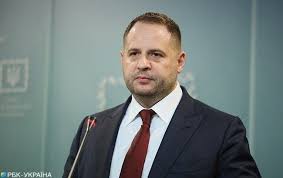
Zelenskyy’s right-hand man has gone. Here’s what should happen next
By Orysia Lutsevych OBE, Deputy Director, Russia and Eurasia Programme; Head of the Ukraine Forum
Ukraine’s second most powerful man resigned on 28 November, just as the country found itself fighting for its life on two fronts – militarily and diplomatically.
Andriy Yermak had served as the head of President Volodymyr Zelenskyy’s presidential office for well over five years, long before Russia’s full-scale invasion of Ukraine in February 2022. All that time he was both a solution and a problem for Zelenskyy.
It was Yermak who assumed a key role in the administration of a war-battered country in 2022, and shaped an international alliance in support of Ukraine. Early in the war, it was Yermak who encouraged Zelenskyy to assume global leadership in the fight against an axis of revisionist autocracies.
After the 2022 invasion Yermak consolidated his influence by handling both domestic and foreign affairs.
Zelenskyy relied on him to shape executive power. It was his job to select the prime minister and ministers, heads of state agencies, and to assert control over areas of law enforcement. The current prime minister, Yulia Svyrydenko, and prosecutor general, Ruslan Kravchenko, are seen as his protégés. He sidelined the parliament to shape the executive, something that goes against the constitution. With Zelenskyy’s party holding a majority, members of parliament were rubber-stamping decisions taken in the Office of the President. It diminished their oversight, and their capacity to course-correct policies. For an unelected official, Yermak amassed enormous power.
Andriy Yermak was not a popular figure inside Ukraine, where he was seen by many as a mastermind behind the centralisation of power, and as a gatekeeper to Zelenskyy. Scandals surrounded his rise to power, including ‘Wagnergate’, an abortive special operation to arrest Wagner mercenaries in 2020.
But it was a corruption investigation in the energy sector that triggered his eventual fall. At this stage he is not a suspect, but Ukrainian civil society believes that it was Yermak who oversaw efforts to curtail the powers of investigative agencies such as the National Anti-Corruption Bureau of Ukraine (NABU) and the Special Anti-Corruption Prosecutor (SAPO), efforts that led to massive protests in the summer.
White House liability
By late 2025 the shadow of Yermak was also complicating intense and excruciating talks with the Americans. In recent weeks Moscow and Washington have dialled up pressure on Kyiv to accept what Ukraine regards as wholly unreasonable peace conditions. Although Yermak was a key part of the negotiating team, Zelenskyy could not risk having Ukraine represented by somebody with a dubious reputation – Russia’s propaganda operatives would certainly have used his presence to make their case to US President Donald Trump that Ukraine was hopelessly corrupt.
Any deal agreed by Yermak would have been a hard sell in Ukraine, and a continuing problem for Zelenskyy as he struggles to shape a war termination strategy that will bring the majority of citizens along with him.
But the ousting of Yermak, though undoubtedly an extremely difficult decision for the President, could – if handled correctly – ultimately strengthen Zelenskyy’s position and Ukraine’s wartime resilience.
The industrial-scale nature of the war and its attritional character require effective mobilization of resources and a stable international coalition in support of Ukraine.
In order to defend Ukraine’s sovereignty and maintain a pathway to restoring its territorial integrity, Zelenskyy needs to increase the country’s military staying power, boost the climate for military-technological innovation, and sustain high morale at home.
To protect its future Ukraine must align its position with Europeans, and ensure that the so-called ‘coalition of the willing’ backs that common strategy with significant resources, some to be transferred directly to state-owned companies and Ukraine’s treasury. Demonstrating that Ukraine is determined to eradicate corrupt schemes and to prosecute graft is fundamental to continued and uninterrupted external finance. In 2026-2027 Kyiv needs around $60 billion to balance its budget.
At home, corruption is increasingly seen as weakening the war effort. A Chatham House survey from July 2025 shows that Ukrainian society sees fighting institutional corruption as the key element of societal resilience in wartime – 64 per cent of respondents identified it as the number one task for Ukraine.
Post-Yermak
However, just replacing one head of the president’s office with another will not be enough. Zelenskyy’s team, together with the parliament and active civil society, must come up with a strategy that would strengthen governance in war, andlay the foundations to win the peace. This means decentralization of power, strengthening the organs of justice, and injecting new talent into leading state agencies.
The anti-corruption agencies and courts must be protected from political interference and allowed to conduct unobstructed investigations, so that those found guilty are brought to justice and the state is compensated for losses.
© Chatham House, The Royal Institute of International Affairs, 2025
Коментар