
'Britain at the heart of Europe': How Starmer's plans are going down in the EU
Katya AdlerEurope Editor, in Brussels
 Getty Images
"A UK prime minister, using the idea of getting closer to the European Union as a political life vest to get the British public on his side? That is certainly not something we in the EU would have predicted. Especially when you think - it's the 10-year anniversary of the Brexit vote next month!"
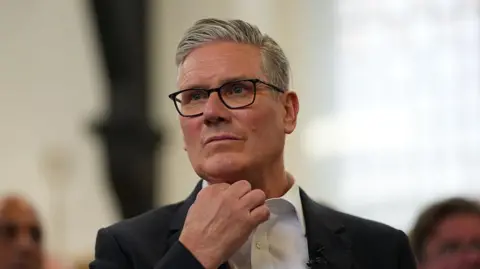
This was the response of an EU contact of mine, here in Brussels. He asked to remain anonymous to be able to speak freely. We were discussing the highly anticipated speech given by Prime Minister Sir Keir Starmer. Following the massive slap in the face he got from voters last week in local elections, he launched a bid this morning to save his political life.
In what was billed to be a defiant address, Starmer pledged to lay out "a platform on which we can build" tighter links with the EU. The place to do that, he seemed to intimate, was around the next EU-UK summit this summer.
"This Labour government will be defined by rebuilding our relationship with Europe, by putting Britain at the heart of Europe, so that we are stronger on the economy, stronger on trade, stronger on defence," he said.
Jill Rutter, former British civil servant and senior research fellow of the think tank UK in a Changing Europe, described his comments as "a damp squib". It lacked even "one single new proposal", she told me.
The response across the Channel is mixed. Quite different on trade and the economy, as opposed to defence and security.
On defence, Europe is very much concentrating on the bigger picture: Iran, the Russia-Ukraine crisis and deteriorating relations with the US under Donald Trump. The UK is viewed as a key and constant ally inside Nato and alongside the EU. On Monday, the UK announced its latest sanctions package against Russia, for example.
That includes continuing to play a leading role in supporting Ukraine and trying to assemble an international maritime force to safeguard ships in the Strait of Hormuz, when the Iran crisis eventually abates.
But when it comes to economic ties with the UK, there is a sense of weary cynicism in Brussels.
On Monday, Starmer proclaimed that: "Incremental change won't cut it on growth, defence, Europe, energy - we need a bigger response than we anticipated in 2024 because these are not ordinary times."
But what does he actually mean by "a bigger response" on Europe?
The EU has been clear with the UK since Brexit. It welcomes the idea of getting closer again, if and when the UK decides that is definitely what it wants.
But the sectors the Labour government has so far been discussing in earnest with the EU, in terms of cutting post-Brexit red tape and barriers, are extremely limited: a food and drink safety agreement, known as SPS, a carbon emissions trading agreement, and a youth experience scheme.
The latter Starmer is now touting as a big part of his push to help especially underprivileged UK youth broaden their horizons, but in actual fact it was a) an EU ask particularly from the Germans, and b) something the Starmer government originally pushed back hard against.
Коментар